
How Do Heat Pumps Work? Benefits for South Texas Homeowners
A heat pump is an HVAC system that can both cool and heat your home. Instead of using separate equipment for air conditioning and heating, a heat pump changes its operation according to the season.
Because the Rio Grande Valley has long summers and generally mild winters, heat pumps can be an excellent option for many South Texas homeowners.
How Does a Heat Pump Work?
A heat pump uses refrigerant to move heat from one location to another. Its main components include:
An indoor air handler and evaporator coil
An outdoor heat-pump condenser
A compressor
Refrigerant lines
A reversing valve
A thermostat
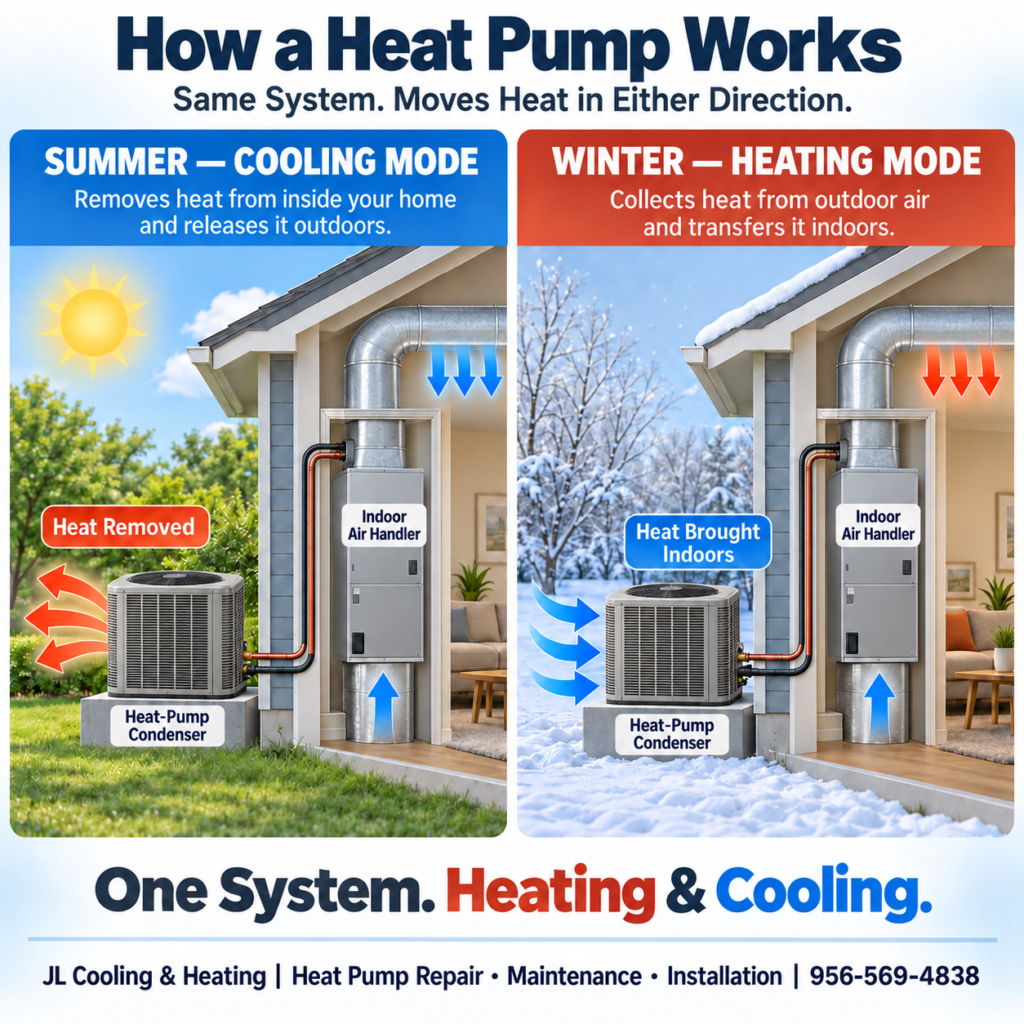
The reversing valve changes the direction in which the refrigerant flows. This allows the same HVAC system to provide cooling during summer and heating during winter.
How a Heat Pump Cools Your Home
During the summer, a heat pump operates like a central air conditioner.
The indoor coil absorbs heat and moisture from the air inside your home. Refrigerant carries that heat to the outdoor condenser, where it is released outside. The air handler then circulates cooled and dehumidified air through the duct system.
In simple terms, a heat pump removes heat from your home and transfers it outdoors.
How a Heat Pump Heats Your Home
During cooler weather, the reversing valve changes the direction of refrigerant flow.
The outdoor coil collects available heat from the outside air. The system transfers that heat indoors, and the air handler distributes warm air throughout the home.
A heat pump can collect outdoor heat even when the weather feels cold because heat energy is still present in the air.
Some systems also include electric auxiliary heat strips. These can provide additional heating during unusually cold South Texas weather or when the indoor temperature needs to rise quickly.
Benefits of Installing a Heat Pump
Heating and Cooling From One System
A heat pump provides air conditioning and heating through the same central HVAC system. This gives homeowners year-round comfort without needing separate cooling and heating equipment.
Energy-Efficient Heating
Instead of creating all its heat through electric resistance, a heat pump transfers available heat from outdoors. Under the right conditions, this can use less electricity than relying entirely on electric heat strips.
Actual energy usage depends on equipment efficiency, thermostat settings, ductwork, home construction, outdoor conditions, and installation quality.
Well Suited for the South Texas Climate
Heat pumps perform especially well in areas with long cooling seasons and relatively mild winters. This makes them a practical option for homes throughout the Rio Grande Valley.
Consistent Indoor Comfort
When correctly sized and installed, a heat pump can provide steady heating and cooling while helping maintain more consistent indoor temperatures.
No Natural Gas Required
A central heat pump operates with electricity and does not require a natural-gas connection or combustion inside the home.
Year-Round Operation
Because the same system provides cooling and heating, homeowners can use their heat pump throughout the year. The thermostat automatically controls which mode is needed to maintain the selected indoor temperature.
Proper Heat-Pump Installation Matters
Even high-efficiency equipment can perform poorly when it is incorrectly sized or installed. Heat-pump performance depends on more than the efficiency rating printed on the equipment.
A professional heat-pump installation should include:
Correct sizing based on the home’s heating and cooling requirements
Verification that the ductwork can handle the required airflow
Properly sealed air-handler and duct connections
Correct refrigerant-line installation
Evacuation of the refrigerant circuit with a vacuum pump
Refrigerant charging according to manufacturer specifications
Static-pressure and airflow testing
Proper thermostat and auxiliary-heat settings
Verification of heating, cooling, and defrost operation
Proper condensate drainage
These details can affect comfort, humidity control, energy usage, reliability, and the system’s useful life.
Heat-Pump Maintenance
Since a heat pump provides both heating and cooling, routine maintenance helps keep it operating correctly throughout the year.
Professional maintenance may include:
Cleaning the indoor and outdoor coils
Inspecting the air filter
Cleaning the blower assembly
Flushing the condensate drain
Measuring airflow and static pressure
Inspecting electrical components
Checking refrigerant performance
Testing the thermostat and reversing valve
Verifying auxiliary-heat operation
Testing the defrost cycle
Confirming proper heating and cooling operation
Regular maintenance also gives a technician an opportunity to identify wear before it affects system performance.
Heat-Pump Services in the Rio Grande Valley
JL Cooling & Heating repairs, maintains, and installs residential heat-pump systems throughout San Juan, McAllen, Mission, Pharr, Edinburg, and surrounding Rio Grande Valley communities.
Our technicians evaluate the complete HVAC system, including the air handler, heat-pump condenser, thermostat, electrical components, refrigerant circuit, airflow, and ductwork.
For professional heat-pump repair, maintenance, or installation, call JL Cooling & Heating at 956-569-4838 or visit jlcandh.com.
JL Cooling & Heating — We don’t sell what you don’t need.