
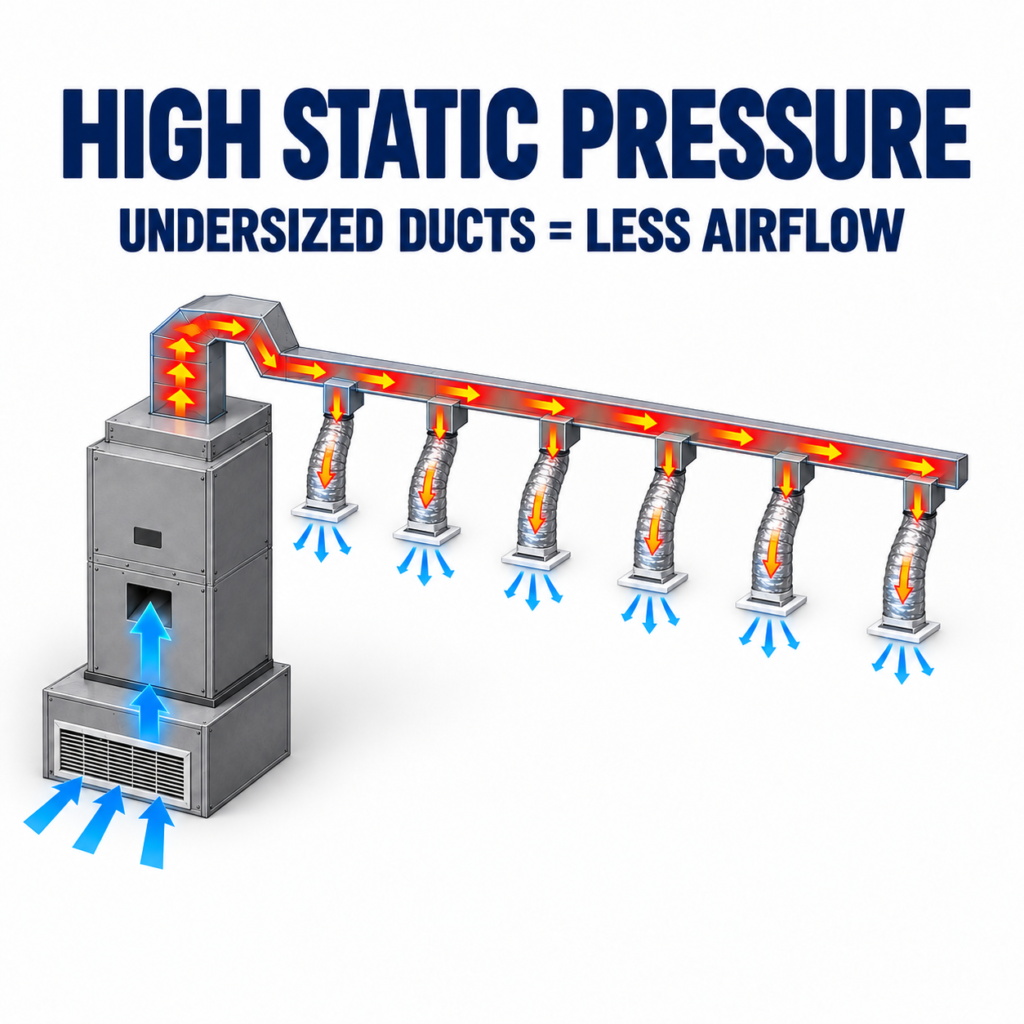
Your air conditioner depends on the duct system to carry conditioned air throughout your home. When the ductwork is too small or restrictive, the blower has difficulty moving the amount of air the equipment requires.
This condition is called high static pressure.
An easy way to understand static pressure is to imagine trying to breathe through a small straw. You can still move some air, but it requires more effort. The same thing happens when an HVAC blower tries to push air through undersized or restricted ductwork.
A Larger AC Requires More Airflow
One of the biggest mistakes made during an AC replacement is installing larger equipment without checking whether the existing duct system can handle the additional airflow.
As a general example:
- A 2-ton AC system commonly requires approximately 800 CFM of airflow.
- A 4-ton AC system commonly requires approximately 1,600 CFM of airflow.
Actual airflow requirements can vary based on the equipment, climate, and humidity-control needs, but the difference is significant.
If a 2-ton system is replaced with a 4-ton system while keeping ductwork that was designed to move approximately 800 CFM, the ducts do not suddenly gain the capacity to move 1,600 CFM. The system may still be limited to approximately the airflow capacity of the original 2-ton duct design.
In simple terms, you may have installed 4 tons of cooling equipment, but the duct system may still only have enough airflow capacity for a 2-ton system.
What Happens When the Supply Ducts Are Too Small?
When the blower attempts to force more air through ducts that cannot handle it, pressure builds inside the system. This can cause:
- Weak airflow from supply registers
- Rooms that cool unevenly
- Longer system run times
- Higher electrical consumption
- Excessive noise from ducts and registers
- Poor temperature control
- Reduced cooling capacity
- Increased strain on the blower motor
- Evaporator coil freezing
- Premature equipment failure
The homeowner may believe the new AC is not large enough because the house still does not cool properly. However, the equipment may be large enough—the duct system simply cannot deliver its capacity to the rooms.
Bigger Equipment Can Make the Problem Worse
Installing a larger AC system is not always the solution to a comfort problem.
Larger equipment requires more airflow. If the return, supply trunk, branch ducts, filter, or registers are too small, increasing the equipment size can create even higher static pressure.
The blower may attempt to compensate by working harder, but it cannot overcome a duct system that is physically too restrictive. Depending on the type of blower motor, this may increase energy consumption, reduce airflow, or place additional strain on the motor.
The result may be expensive new equipment that still produces:
- Weak airflow
- Uneven room temperatures
- High humidity
- Excessive noise
- Long run times
- Repeated airflow-related repairs
High Static Pressure Can Reduce Cooling Performance
An air-conditioning system needs the correct amount of air moving across the evaporator coil.
When airflow is too low, the coil may become excessively cold. This can reduce system capacity and may eventually cause the evaporator coil to freeze.
A frozen coil blocks even more airflow, creating a cycle in which the system runs but cannot properly cool the home.
Low airflow can also affect refrigerant readings. That is why airflow and static pressure should be checked before assuming that a system simply needs refrigerant.
The Return Side Matters Too
High static pressure is not limited to the supply ducts. The return side must also be large enough to bring the required amount of air back to the air handler.
Common return-air restrictions include:
- Undersized return grilles
- Small return ducts
- Restrictive air filters
- Dirty filters
- Blocked return grilles
- Poorly designed filter bases
- Sharp duct transitions
- Dirty evaporator coils
A system cannot supply more air than it can receive through the return.
How Is Static Pressure Checked?
An HVAC technician can measure total external static pressure using a manometer. This test shows how much resistance the blower is working against.
Additional testing may include:
- Return and supply static-pressure readings
- Pressure drop across the air filter
- Pressure drop across the evaporator coil
- Airflow measurements
- Blower-speed verification
- Duct and register inspection
- Temperature measurements
- Equipment airflow requirements
Static pressure should be compared with the air handler manufacturer’s approved operating range. A single number should not be judged without considering the equipment specifications and where the readings were taken.
Should the Ductwork Be Checked Before Replacing an AC?
Yes. Before changing equipment size, the contractor should evaluate whether the existing return and supply duct systems can support the new system’s required airflow.
Proper system replacement may require:
- A Manual J load calculation to determine how much heating and cooling the home needs
- Manual S equipment selection
- Duct-sizing and airflow evaluation
- Static-pressure testing
- Return-air improvements
- Larger supply trunks or branch ducts
- Additional or properly sized registers
Equipment size and duct capacity must work together. Installing larger equipment without correcting an undersized duct system may reduce comfort, efficiency, and equipment life.
HVAC Airflow Testing in the Rio Grande Valley
South Texas air conditioners operate under demanding heat and humidity conditions. Proper airflow is especially important when equipment runs for extended periods during the summer.
JL Cooling & Heating evaluates static pressure, airflow, duct sizing, return capacity, and overall AC performance throughout San Juan, McAllen, Mission, Pharr, Edinburg, and surrounding Rio Grande Valley communities.
If your AC has weak airflow, uneven temperatures, excessive noise, high humidity, or long run times, the problem may not be the equipment itself. Your duct system could be restricting its performance.
Call 956-569-4838 or visit https://jlcandh.com to schedule an evaluation.
JL Cooling & Heating
“We don’t sell what you don’t need.”