
If your home feels sticky, damp, or uncomfortable even when the air conditioner is cooling, you may assume you need a whole-home dehumidifier.
Sometimes a dehumidifier is the right solution—but not always.
Here in San Juan, McAllen, Edinburg, Mission, Pharr, and throughout the Rio Grande Valley, high outdoor humidity makes moisture control an important part of home comfort. Before adding another piece of equipment, it is important to determine why the indoor humidity is high in the first place.
This is especially important with today’s spray-foam insulated homes.
At JL Cooling & Heating LLC, we believe the first question should be:
Is the home producing a humidity problem, or is the HVAC system not removing enough moisture?
What Should Indoor Humidity Be?
For many homes, an indoor relative humidity around 40% to 60% is generally comfortable, with conditions often feeling better toward the middle of that range.
In South Texas, maintaining lower humidity can be challenging because of our hot and humid climate.
If your home regularly stays above 60% relative humidity, especially while the air conditioner is operating normally, it may be worth investigating the cause.
Simply lowering the thermostat isn’t necessarily the answer.
How Does Your Air Conditioner Remove Humidity?
Your AC system does two jobs:
It lowers the temperature, and it removes moisture from the air.
When warm indoor air passes across the cold evaporator coil, moisture condenses on the coil and drains away through the condensate system.
But the air conditioner needs adequate runtime to remove that moisture.
This is where AC sizing becomes extremely important.
Could Your Air Conditioner Be Too Large?
Yes.
An oversized AC system can cool a house very quickly.
That sounds like a good thing, but it can create a comfort problem.
The thermostat may reach its temperature setting before the air conditioner has operated long enough to remove enough moisture from the air.
The result can be a home that is 72°F or 74°F but still feels humid and uncomfortable.
This is one reason we don’t recommend choosing an air conditioner based only on the size of the old system or the square footage of the house.
A home that had a 4-ton system before doesn’t automatically need another 4-ton system.
Spray-Foam Homes Can Change the Cooling Load
Spray-foam insulation can dramatically change how a house gains and loses heat.
A properly constructed foam-insulated home can have a significantly lower cooling load than a similar home with traditional insulation and a vented attic.
That means equipment sizing becomes even more important.
For example, replacing an older AC system with the same tonnage after a home has been improved with spray foam could potentially leave the house with more cooling capacity than it actually needs.
The AC may satisfy the thermostat quickly while struggling to provide the longer cycles needed for effective moisture removal.
That doesn’t mean spray foam is causing the humidity problem.
It means the house and HVAC system need to work together as a complete system.
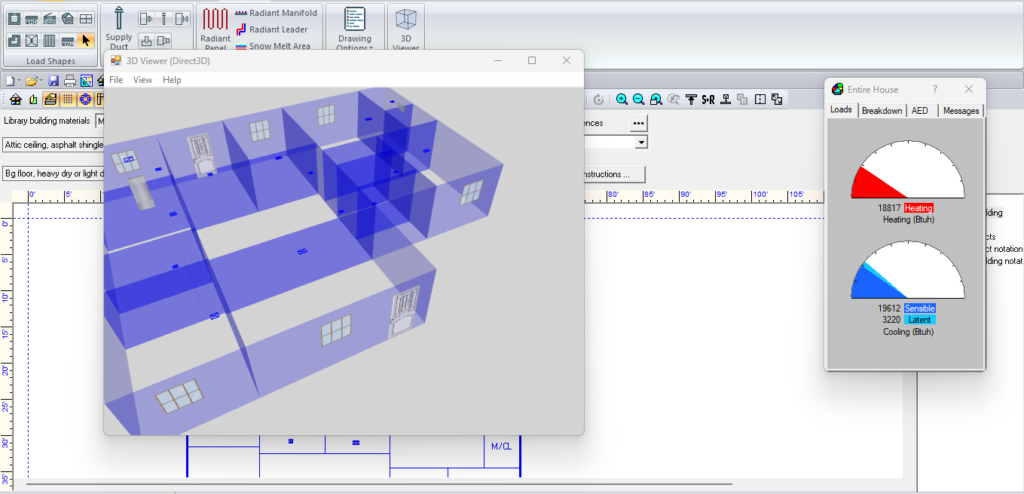
Was a Manual J Load Calculation Performed?
Before installing or replacing an HVAC system, one of the most important questions is:
Was a proper Manual J load calculation performed?
A Manual J calculation determines how much heating and cooling the home actually requires.
It considers factors such as:
- Home size and layout
- Insulation type and R-value
- Spray-foam location
- Windows and doors
- Window orientation
- Ceiling height
- Air leakage
- Construction materials
- Occupancy
- Internal heat loads
- Local outdoor design conditions
This is particularly important with spray-foam homes in South Texas.
Simply using a rule such as “one ton per certain number of square feet” doesn’t account for how the house is actually constructed.
What Is Manual S and Why Does It Matter?
Manual J tells us approximately how much heating and cooling the house needs.
Manual S helps us select equipment that can properly meet that calculated load.
These are two different steps.
A contractor shouldn’t simply calculate the load and then choose equipment based only on the tonnage printed on the condenser.
The actual performance of the equipment needs to be considered.
This includes both sensible cooling and latent cooling.
Sensible Cooling
Sensible capacity primarily deals with lowering the temperature.
Latent Cooling
Latent capacity deals with removing moisture from the air.
In a humid climate like the Rio Grande Valley, both matter.
A system can be excellent at lowering temperature but still leave homeowners uncomfortable if moisture removal isn’t adequate.
What About Variable-Speed and Inverter AC Systems?
Two-stage, variable-speed, and inverter HVAC systems can provide advantages for humidity control because they can often operate at reduced capacity for longer periods.
Longer operation can provide more opportunity for moisture to condense on the evaporator coil.
But even advanced equipment needs to be properly sized, configured, and installed.
Installing an oversized inverter system isn’t a substitute for determining the home’s actual cooling requirements.
Could Airflow Be Causing High Humidity?
Equipment size isn’t the only thing we look at.
Airflow can also affect how an air conditioner removes moisture.
The HVAC system needs to be properly configured for the equipment and application. Blower settings, ductwork, static pressure, filtration, evaporator coil performance, and equipment setup can all affect system performance.
Other potential causes of excessive indoor humidity can include:
- Air leaks around doors and windows
- Duct leakage
- Outside-air infiltration
- Improper ventilation
- Bathroom or kitchen moisture
- Condensate drainage problems
- HVAC equipment or control problems
- Incorrect blower settings
- Building-envelope issues
With a spray-foam home, ventilation and building pressure also deserve attention because the house may be considerably tighter than a conventionally insulated home.
So, Do I Need a Whole-Home Dehumidifier?
Possibly—but we shouldn’t automatically start there.
A whole-home dehumidifier can be an excellent solution when a home has a legitimate latent moisture load that the properly sized HVAC system cannot adequately handle on its own.
But if the real problem is an oversized AC system, incorrect airflow, duct leakage, equipment configuration, or another HVAC issue, simply adding a dehumidifier may treat the symptom without addressing the underlying cause.
Before recommending one, we believe it makes sense to ask:
Is the AC properly sized?
Was a Manual J performed?
Was the equipment properly selected using Manual S?
Is the airflow correct?
Is the HVAC system operating as designed?
Is outside moisture entering the home?
How tight is the building envelope?
Once those questions are answered, we can make a better decision about whether additional dehumidification is actually necessary.
High Indoor Humidity in San Juan and the Rio Grande Valley?
If your home is cool but still feels humid, don’t automatically assume you need a bigger air conditioner—or immediately purchase a dehumidifier.
There may be a reason your existing HVAC system isn’t controlling moisture properly.
JL Cooling & Heating LLC can help evaluate AC performance, airflow, equipment sizing, and indoor humidity concerns for homeowners in San Juan, McAllen, Edinburg, Mission, Pharr, Alamo, and surrounding Rio Grande Valley communities.
For new and replacement systems, proper Manual J load calculations and Manual S equipment selection can help ensure that the air conditioner is selected for the home’s actual cooling requirements rather than simply replacing the old equipment with the same tonnage.
The goal isn’t just to make your home cold.
The goal is to make it comfortable.
JL Cooling & Heating LLC
We don’t sell what you don’t need.